

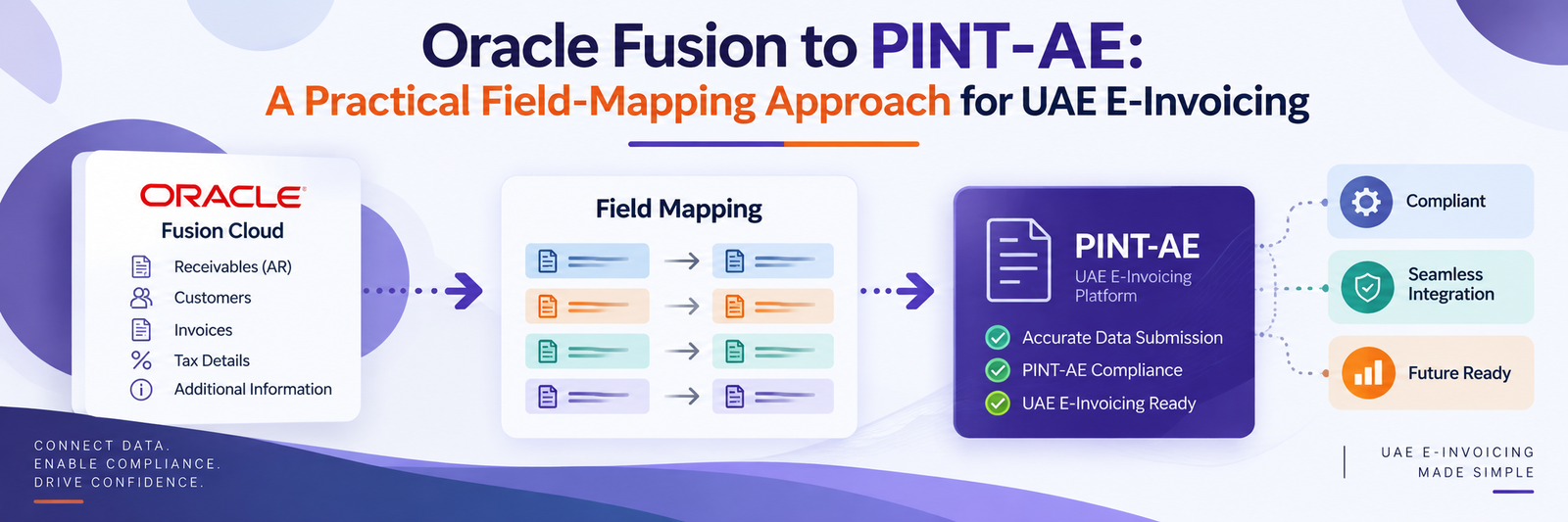
Oracle Fusion to PINT-AE: A Practical Field-Mapping Approach for UAE E-Invoicing

One of the first technical questions in a UAE e-invoicing project is simple to ask but difficult to answer: where will every required invoice field come from?
For Oracle Fusion customers, a field-mapping exercise should happen before the interface is built. If it is delayed, the integration team may finish development only to discover that important information is missing, inconsistent or owned by another application.
PINT-AE is not just an XML exercise
The UAE electronic invoice requirements define the data that needs to be carried in a structured invoice. PINT-AE provides the semantic model used for interoperable exchange through the Peppol framework.
The common mistake is to start by looking at XML tags. A better approach is to start from business meaning.
- For every required element, ask:
- What does this field mean in the UAE context?
- Which business process creates it?
- Where is it stored today?
- Who owns its accuracy?
- Is it available before invoice completion?
- Does it change by legal entity, transaction type or customer?
- Only after those questions are answered should the technical mapping be finalised.
Build a mapping matrix
A useful mapping workbook contains structured field columns separating data availability from transformation logic. Below is the recommended matrix structure:
| PINT-AE & UAE Term | Oracle Source & Field | Governance & Logic |
|---|---|---|
| PINT-AE business term UAE requirement |
Oracle source Oracle object/field |
Transformation logic Default allowed? |
| Party identifiers Delivery & routing address |
RA_CUSTOMERS / HZ_PARTIES Flexfield extensions |
Mandatory by scenario? Data owner assignment |
| Line tax category & rate Invoice totals in AED |
RA_CUSTOMER_TRX_LINES ZX_LINES tax repository |
Validation rule checks Test case reference ID |
For example, invoice number, date, currency and line values are usually straightforward. Party identifiers and references can be more difficult, especially when different legal entities use different customer setup standards.
Standard field, extension or enrichment?
We normally classify each mapping into four distinct operational buckets:
The data already exists in the required transaction or master record and can be extracted directly.
The business already knows the value, but it is not stored in a suitable standard field. A descriptive flexfield or another supported extension may be appropriate.
The value belongs to another system, such as a CRM, project application or e-commerce platform. The integration layer needs to enrich the invoice before sending it to the ASP.
The organisation does not consistently capture the information today. This is not an integration problem. Finance or master-data governance needs to change the process.
Customer and supplier data deserve special attention
ERP implementations often contain years of accumulated master data. Some records are complete; others were created for older operating models. UAE e-invoicing can expose those inconsistencies quickly.
Review customer legal names, tax identifiers, addresses, endpoint or routing identifiers where applicable, and the relationship between account, site and legal entity. The same exercise should be performed for suppliers if inbound e-invoicing is in scope.
Line-level information can be harder than header data
Finance teams often focus on invoice header fields, while e-invoicing requirements may depend on accurate line-level values and references. Key line items to audit include:
- Item/service descriptions
- Quantities and units of measure (UOM)
- Taxable amounts and currency breakdowns
- Tax category and applicable rate
- Discounts and allowance charges
- Purchase order or contract references
- Project or service-period information where relevant
If upstream systems summarise transactions before sending them to Oracle, confirm that sufficient detail remains available for the e-invoice.
Avoid excessive hard-coding
A mapping that depends on dozens of legal-entity-specific if/else rules becomes difficult to maintain. Where possible, use configuration tables for entity-level parameters, mappings and defaults.
This is particularly important for organisations operating multiple UAE legal entities. A central mapping service can handle common logic while allowing controlled entity-level variation.
Validate mapping with real invoices
Do not test mapping only with artificially clean examples. Take a representative sample from production-like data:
- Normal domestic invoice
- Credit note
- Invoice with multiple tax rates if applicable
- Foreign-currency transaction
- Invoice linked to a purchase order or contract
- Advance-related transaction
- Retention or project billing scenario where relevant
- Manual invoice
- Interface-created invoice
Then trace every required data element back to its source.
Keep the mapping as a controlled project asset
The mapping workbook should not disappear after go-live. Regulatory requirements and business processes will evolve. Treat it as controlled documentation with ownership, versioning and change approval.
It will also make future ASP changes or integration redesign much easier because the organisation retains its own semantic mapping rather than depending completely on vendor-specific code.
Final thought
The strongest UAE e-invoicing integrations are built on good data mapping, not clever transformation code.
For Oracle Fusion customers, the mapping exercise is where Tax, Finance and IT finally see the same invoice from the same perspective. That is why it should be one of the first workstreams in the project, not a technical task left until the end.
Official references & internal links
- Internal Link: UAE E-Invoicing Data Dictionary: PINT-AE Field Mapping Guide
- Internal Link: UAE E-Invoicing Readiness for Oracle Fusion: The 2027 Guide
- Source: UAE Ministry of Finance eInvoicing Portal (mof.gov.ae)
- Source: UAE Electronic Invoice Mandatory Field Requirements
- Source: OpenPeppol / PINT AE International Billing Specifications