

Simplifying Data Transformation with XSLT Mapper in Oracle Integration Cloud

Data transformation is a crucial component of any integration process. In Oracle Integration Cloud (OIC), the XSLT Mapper simplifies this task, allowing developers to visually map data between source and target systems. This tool empowers users to transform complex data formats with minimal coding, streamlining integration development.
What Is the XSLT Mapper in OIC?
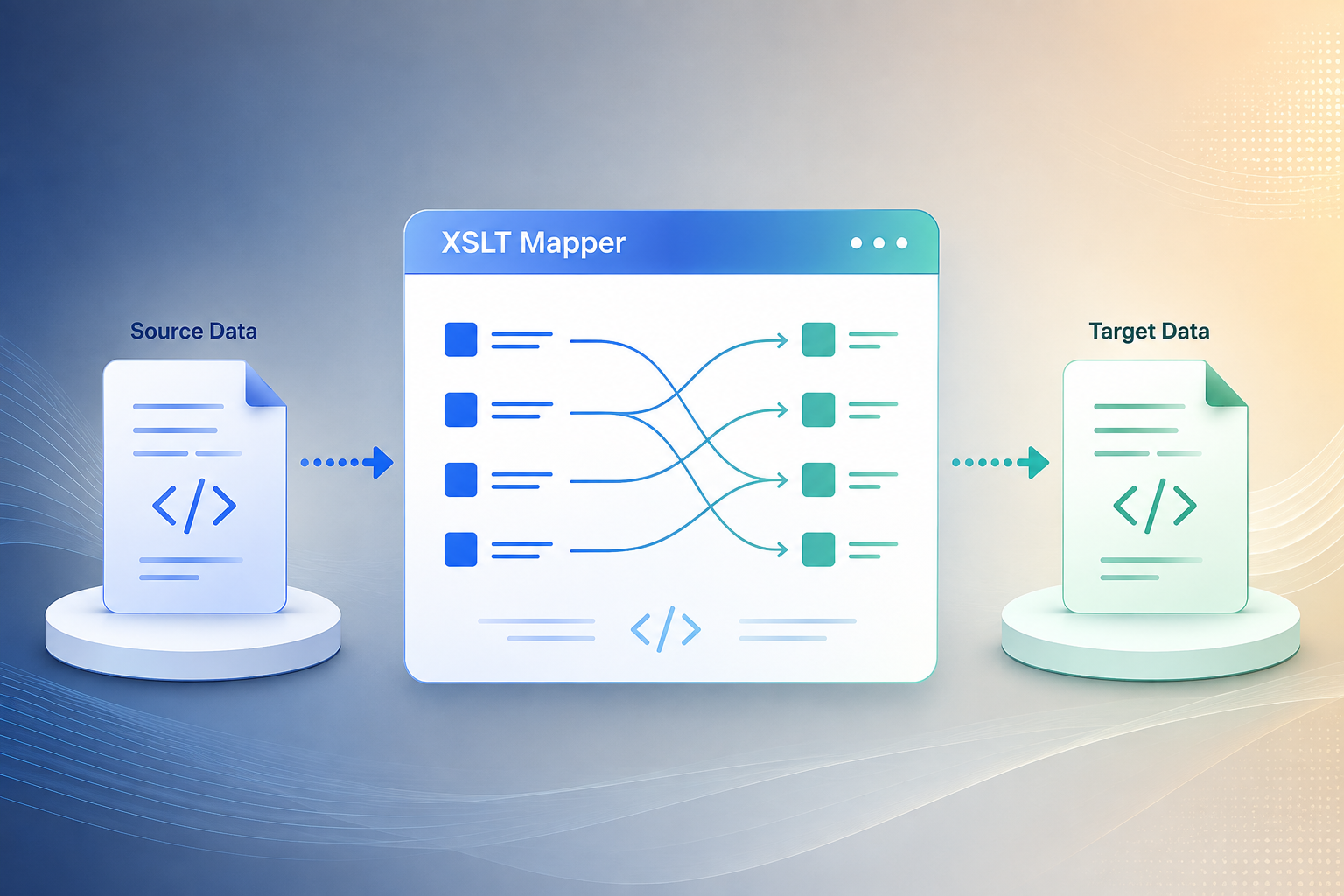
The XSLT Mapper in OIC is a visual tool for creating transformation logic between two data structures. It uses Extensible Stylesheet Language Transformations (XSLT) to define the rules for converting source data into the target format. Its intuitive drag-and-drop interface removes the need for manual XSLT coding in most scenarios.
How XSLT Mapper Simplifies Data Transformation
Visual Representation
The mapper displays source and target schemas in a tree-like structure, making complex hierarchies easier to navigate and understand.
Prebuilt Functions
Apply date formatting, string operations such as concatenation and substring, and arithmetic calculations directly in the mapper.
Intuitive Mapping
Connect source and target fields by drawing a line between them. Configure conditions and loops for arrays or repeating elements through context menus.
Error-Free Transformation
Validate mappings during development to check data-type compatibility and transformation accuracy.
Code-Free Experience
Create robust transformations with limited XSLT or XPath knowledge through visual aids and an intuitive interface.
Example Use Case: Mapping Customer Data
A business needs to transform customer data from one application into a format compatible with another.
<!-- Source XML -->
<customer>
  <firstName>John</firstName>
  <lastName>Doe</lastName>
  <dob>1990-01-01</dob>
</customer>

<!-- Target XML -->
<customerdetails>
  <fullName>John Doe</fullName>
  <birthdate>1990-01-01</birthdate>
</customerdetails>
Benefits of XSLT Mapper in OIC
Conclusion
The XSLT Mapper in Oracle Integration Cloud is a game-changer for data transformation tasks. Its visual approach, robust features, and ability to simplify integration development make it essential for modern cloud integrations.